
BSS News 28. 8. 2012
Diary of BSS 2012
18 August 2012
We start relatively early in the morning by preparing the school premises, which we have reserved. The school has some new floor surfaces and so it is important to ensure that we do not damage them by our activity. We designate the path from the bus stop. Martin arrives, we work on marking the space and then the nametags. The first participants appear already in the morning, so sometimes we have to stop working, accommodate the participants, collect their fees and of course chat a bit. The longer I organize this school, the more I feel that a friendly conversation with the participants can do more for the future of this event than if I engaged Michael Flatley as teacher. The summer school is undoubtedly also about personal relationships; the younger participants or those who are here for the first time just do not know it yet.
In the afternoon we set off together with Zdeněk Utišil to the airport in two cars to pick up teachers. They are accommodated in the premises of Jedlička Institute at Vyšehrad. Before the evening Tereza Be picks up new teachers, Ruadh Duggan and Pat Murphy and shows them the public transport route to the place of their future activity.
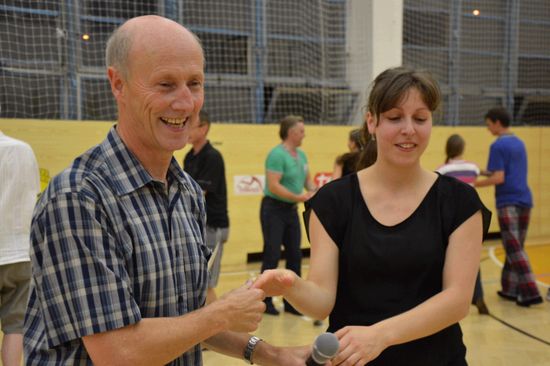
Pat Murphy and Tereza Bernardová – photo V.Bernard
The evening ceilí is opened by a country dance ‘A Twisted Chain’, which we managed to teach and dance with minor problems. Pat Murphy continues with a two-hand dance Peeler and the Goat and another dance, whose name I did not remember.
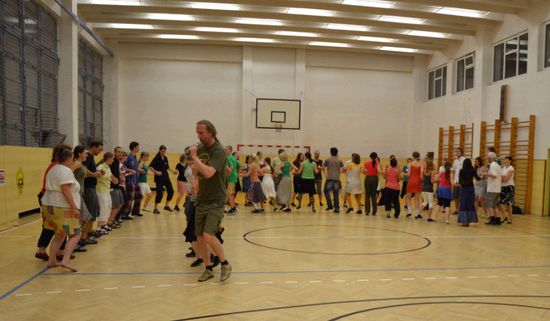
Roman Kozák and Breton’s Dance – photo V.Bernard
I add two Scottish Dances (Cumberland Reel and Highland Welcome), further dance programme in the rhythm of Brittany is in the hands of Roman Kozák. At the very end we conclude with a Country Waltz.
19 August
In the morning at 8.30 we officially open the 12th Summer School in the presence of those whose lessons start before noon. Beside step dancers these are mainly participants of fiddle lessons. A group of 40 dancers remains in the large gym, where a team of tutors, Tereza and Tereza and Andrej take charge of them. The second gym is filled with the most advanced dancers and Ronan. Fiddlers and beginner dancers go to their reserved classrooms. Gradually, further lessons of the day start up – Anna Novosadová boldly takes the lead of the ceilí lesson, Máire Bríd opens sean nós singing for her 12 pupils, harp teacher Václava comes to start her lesson. Ceilí lesson participants learned four dances on the very first day (Everyman’s Chance, Richie’s Set, Walls of Limerick and An Rince Mór). Great gym is later occupied by Tereza Bernardová with those interested in sean nós dancing lessons. The rest of the musical instrument lessons – bagpipes, whistle, bodhrán – open in the afternoon. Set dancers arrive to launch their lessons under the leadership of Pat Murphy. Pat starts teaching the Ballyvourney Reel Set, continues with a Mezerks Set and starts the Black Valley Square Jig Set.
During the afternoon, one dancer leaves the summer school with a ruptured Achilles tendon. I take her home from the hospital and this summer school is unfortunately over for her.
After the evening programme we offer to those who are interested a screening of a documentary about the Cunningham family called In the Blood. The Cunningham family of Tuam is known for their dance show in the sean nós dancing style. Besides the passages where family members talk about their dance beginnings, sean nós dancing etc., viewers can also see excerpts from the show, which has been very successful in Ireland and especially in America. Its success lies mainly in the dynamics of dance, supported by live and stirring music.
During the afternoon I managed to install an exhibition of photographs by Radovan Wulf Vlk from Brno, who is originally a dancer of Démáirt Irish dance group. He has been involved in photography from his youth and the results of his activities, which he sometimes publishes on Facebook, captured my interest. Although we first talked about photos from dance events, I finally asked him for a general collection of photographs.
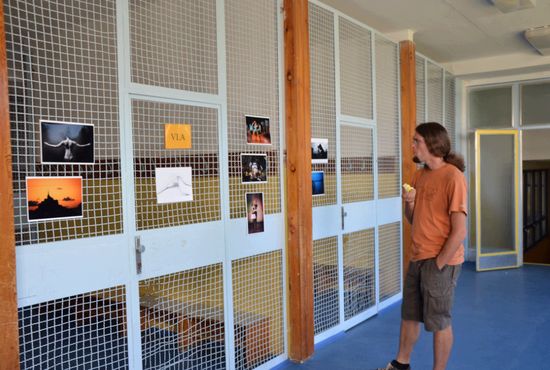
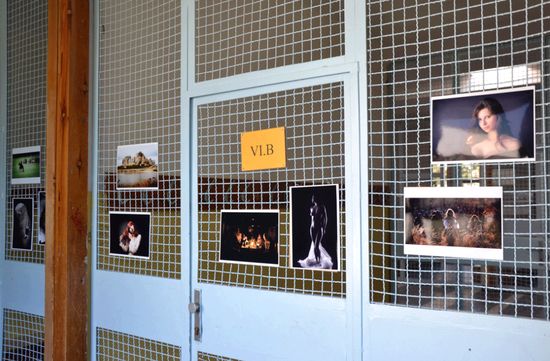
Exhibition of photos by Radovan Wulf Vlk – photos V.Bernard
The exhibition did not have an official opening and crowds did not gather around it, but I noticed that someone stopped by to see the photographs here and there during the summer school. And that’s what I’ve been hoping for.
20 August
In the morning I prepare another dance „workplace“ in Mráčkova primary school for a group of dancers, led by Tereza Bernardová. Meanwhile, lessons also begin at Zárubova primary school, for dancers led by Tereza Loužecká Bachová and Andrej Mikulka, beginner dancers led by Markéta Utišilová, musicians led by Ruadh Duggan and Václava van der Meijs. Other lessons are going according to plan, with some minor variations by agreement of the participants with the teacher. Ceilí dancers learn next three dances (Siege of Ennis, Haste to the Wedding, Harvest Time Jig). There are other latecomers who enter the lessons after its „maturing“. Set dancing lessons complete the Black Valley Square Jig Set commenced yesterday and continue with Claddagh Set.
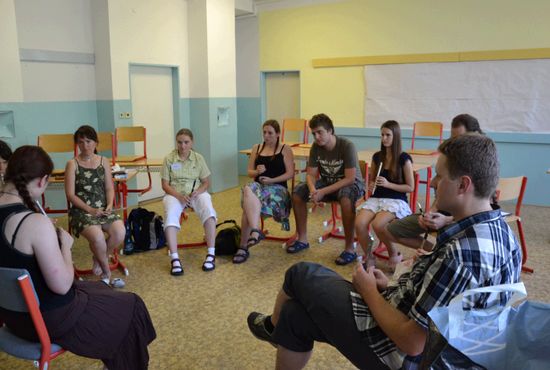
Whistle class under leading of Anna Šůrová – photo V.Bernard
The end of the day features a seminar on the prospects for Irish dance, to which I invited all dance teachers and was attended by about 15 participants from among the dancers. I opened the seminar by reasoning that dancing is a social activity that should bring people together to have fun, but this is a problem in Irish dancing – at least in our country – it rather divides people. The reasoning ended with a question whether this development in Irish dance is normal or is some sort of exception, or wayward social development. Ronan McCormack confirmed my opinion that Irish dancing has to go through this in each country and that it may be a rather long process. In some way, the same can be said about Irish dancing in its cradle. The discussion was further on focused mainly on step dancing, specifically about its competitive form and organization. Ronan pointed out some discriminatory practices in this area, which are rooted in the rules, different approaches in solving the same problems, including transfer rules. On the other hand he gave some hope that things are in motion and the election / replacement of top leaders could mean a chance for change. There were questions raised about the difference between the major Irish dance organizations, the possibilities to access information, the update of the collection of Thirty Ceilí Dances and Ronan mentioned some new tendencies in rule changes.
21 August
On Tuesday lessons take place according to schedule. The ceilí lessons participants learned the following dances: the Galway Reel, The Sweets of May. In the afternoon set dancing lessons, Pat Murphy completes the Claddagh Set and adds the Ballingeary Set. An afternoon seminar on ‘How not to kill a dance group’ has not been significantly promoted and therefore took place in the form of easy conversation with the one participant present. A one-hour dance workshop entitled Rhythm and technology for step / sean nós dancers was announced for the early evening, prepared by Andrej Mikulka. It was attended by over 30 participants.
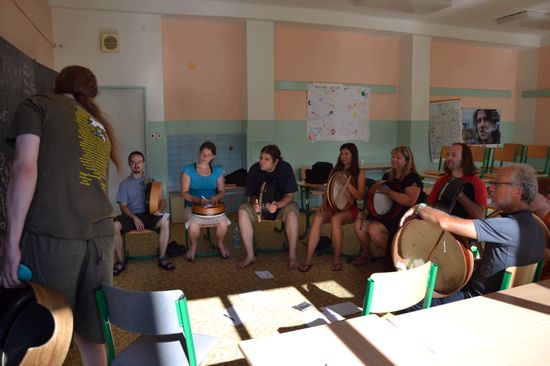
Roman Kozák is teaching bodhrán playing – photo V.Bernard
Tuesday evening is traditionally a time for a session in a nearby pub under the Billa supermarket, where musicians and dancers from summer school come together. Although the event started as promising, the smoky pub environment did not give hope for much success and so everyone around transferred to the school around 11 pm where the session continued. The originally planned film screening was cancelled.
22 August
Wednesday’s lesson programme proceeds according to schedule, but everything slowly concentrates on the ceilí evening. Dancers from Ceilí lessons learn the Fairy Reel and The Three Tunes and set dancers led by Pat Murphy to expand their repertoire by the Fermanagh Quadrilles and Glencree Set. Lessons and a part of the evening are attended by Andrea Forstner and her husband Christian from Erlangen.
The evening ceilí invitation was accepted by musicians who play under the name The Flying Druid’s Orchestra, but in essence they are players without whom no local music session can happen: Marek Poledna, Dan „Fána“ Vališ, Pepa Janíček, Jan Banis, Martin Sedláček and Lukáš Radostný. Towards the end the band was also joined by Michel Sikiotakis. After a musical opening we start dancing right away. The first dance taught from Elizabeth Burchenal’s collection is called Donegal Round Dance and could prospectively belong to those that are more likely to appear in teaching for its simplicity. I further add the Siege of Ennis, which is contained in the same collection as a reel. Further dance programme is led by Pat Murphy, who teaches two figures from the Connemara Set. Katka Báňová continues by teaching Denis Murphy’s Reel and Anna Novosadová follows with the Haymakers Jig. Then we asked Pat for two-hand dances, which he readily took up. He first taught the Donegal Highlands for 2 people and then a dance of the same name for three people. I added another Polka from the Williamstown set thus make use of the „lacing“ figure learned in the Haymakers Jig. The conclusion consists of the Walls of Limerick and Two Hand Country Dance. This evening was among others also attended by Klára Zíková English, a former founding member of Rinceoirí, now living in the U.S..
As I learned later, musicians moved to the school and the ceilí evening turned into an excellent informal session.
23 August
Thursday is marked by a little tiredness from the previous days, and especially from the previous evening. However, lessons continue in undiminished form according to schedule and conversely the pace begins to escalate with regard to the upcoming Final Evening of BSS 2012. I witnessed a seemingly humorous situation at a lesson led by Andrej, when after the question „Hands up who of you have practised?“ Andrej follows the dancers’ raised hands by saying: „I praise you that you have practised, but not enough.“ Andrej’s approach impressed me even just because it was for the benefit of those teaches and I also realize that not every teacher can afford to say this. Only one that has had unquestionable education, dance skills and teaching abilities. And frankly speaking, there are very few of such ones on the local Irish dance scene, even though many pretend that they are the chosen ones to pass on dancing skills. Teachers sign the prepared Attendance Certificates and since set dancing lessons end today, Pat also distributes them during his lesson. The last set dancing lesson focused on Doire Cholmcille Set and Portmagee Set. The ceilí dancers learned The Rakes of Mallow and Bonfire Dance.
In the afternoon, I set out with Markéta to the airport to pick up guests of our this Final Evening, David Geaney and his mother. After accommodation Tereza takes them to town and shows them some sights in the city. The next scheduled film screening takes place in the evening, showing Neil Jordan’s Ondine with Colin Farrell in the lead role. It was also screened at the Zlín Film Festival this year. Meanwhile the gym is occupied by groups preparing their part for the Final Evening as they were given the opportunity to showcase some of their repertoire.
24 August
Friday takes place rather rapidly, since the lessons are shortened with respect to the BSS 2012 Final Evening and the dress rehearsal before it. All classes are working hard to polish their programme. Musicians have their rehearsal at school in the afternoon to avoid having to use the space in Ponec, which is needed by dancers more.
I arrive in Ponec at about 5 pm and Andrej’s class are almost done with their run-through. One can see that Andrej really leaves nothing to chance.
Since the Final Evening will have its own separate article, I will just limit myself here to say that it was composed of about 27 entries that took up approximately 3.5 hours. There were about a hundred paying visitors, but the auditorium was also filled with VIP guests, teachers etc.
After the closing night at Ponec the Summer School participants in the vast majority moved to the U Čertíka pub which was near the BSS venue and stretched the evening with a session.
25 August
I arrive at the school in the early hours of the morning to replace Jakub Částka in his position of receptionist, as he leaves home at about 6 am. Individuals and groups gradually begin to leave the school, depending on how they need to get home. By twelve o’clock, which is the limit for leaving the school, we had time to clear out all waste, remove signage and decoration, move the technical equipment, clean up the teaching and sleeping classrooms and even managed to bring the kitchenette in a tolerable state.
I can not avoid mentioning the kitchen, which is annually the weak link of the accommodation space. It is not ideal for the use of several dozen people. However, that should all the more be a reason for everyone washing and cleaning up all dishes immediately after use, putting groceries in their place and rubbish into the designated containers. The reality was, unfortunately, quite different – such that I would not expect from adult humans. During my occasional visits when I liquidated waste in the kitchen the sight of the place certainly did not encourage my appetite.
Finally there was no choice but to pick up the Irish teachers in a minibus and drive them to the airport. When saying goodbye, I realized how little time I had for each one of them, as it would have been nice to have the space and time to sit and chat with each of them and let them tell me something about their view of the school and the Irish events in the country. Also one of the few opportunities to see my daughter of Tereza who lives in Ireland passed like a fast train and thus the welcome and farewell remains as the strongest experience.
Bernard’s Summer School 2012 is over and at the end I have already handed out stickers with the dates of BSS 2013. What to say about this last one? From my point of view it was very demanding, mainly due to the almost tropical temperatures that dominated the entire time. I admired all the dancers that were still able to move even in such weather. I had a great feeling since whenever I was passing through the school I heard the music from the instrumental lessons somewhere, someone was constantly practicing steps in the gym or in the corridors, musicians sought out different nooks where they tried to practice undisturbed – the school was simply alive by what everyone came here for. And they once again managed to create the atmosphere which is the reason why people come here – many of them told me in a conversation that they could not imagine being somewhere else at this time and thank me for organizing the summer school. I want to be fair in this direction and I do not want to attribute undue merit: I have an influence in organizing this event, but I do not create the atmosphere, it is made by all the participants together. So in this aspect, you can all thank yourselves.
I am not pleased that many dancers are forbidden to participate in this summer school. BSS is intended for the general musical and dancing public interested in Irish culture, and I think I can I say without exaggeration that this is the largest event of its kind in Central Europe. A selection of high quality teachers, guests and a motivating environment are able to advance each participant, which can have a positive impact on groups or schools from which these participants originate. It will probably still take some time before anything can change. I do not understand that at least some of those who can not / do not want to participate in the summer school do not at least come to see the Final Evening. I think that Irish dancing is not just about 40 bars danced at a competition and I am all the more pleased that more and more dancers are getting interested in the interpretation of Irish traditional music and attend music lessons (the same but in a reduced extent applies to musicians in relation to dance) or sean nós singing.
A visit to the Final Evening is not subject to anyone’s consent and it is a pity that such voluntarily worn „blinders“ of ignoring this event are particularly hampering some of the dancers in their broader outlook.
BSS 2012 was attended by about 140 participants, of whom musicians were about a third. These participants attended over 200 lessons in total. BSS participants came to Prague from 10 countries – alongside the Czech Republic there were participants from Slovakia, Poland, Germany, Belarus, Russia, Estonia, Italy, Denmark and Ireland. This year’s BSS 2012 received a grant of CZK 15.000, – from Prague 12. The dates of the next summer school were announced – BSS 2013 will be held from 17 to 23 August 2013.
In conclusion, I would like to ask both the participants and teachers for their comments on this BSS. We are especially interested in critical perspectives that can help us, the organizers, in the preparation and implementation of the next summer schools.
V. Bernard
Václav Bernard
